
Dubai, security, and the Marbella contrast
- Estelle Cocomazzi

- Mar 23
- 3 min read
For years, Dubai was presented as one of the safest places in the world for international investors and high-net-worth buyers. Efficient, controlled, modern, stable. In the real estate world, that promise of security became almost inseparable from the city’s appeal.
And yet, current events are forcing a more uncomfortable conversation.
As tensions linked to the Iran-US-Israel conflict escalate across the region, Dubai is no longer perceived only through the lens of growth, glamour, and opportunity. It is also being viewed through a geopolitical lens. That matters.
The myth of absolute safety
Dubai has built an extraordinary reputation. Strong infrastructure, global connectivity, tax appeal, luxury developments, and a highly efficient environment made it feel, for many, like a near-perfect safe haven.
But no market exists in a vacuum.
What we are seeing now is a reminder that even the most polished and well-managed destination remains exposed to the realities of its region. When conflict intensifies in the Gulf, the question is no longer just about local order or urban security. It becomes a question of geopolitical exposure.
That is a very different kind of risk.
Why this changes the conversation
For international buyers, especially those purchasing at the high end, security is never just about crime rates or private compounds. It is about continuity. Airspace. Regional stability. Mobility. Confidence. The ability to move family, capital, and lifestyle without disruption.
When a market becomes associated with military escalation, missile threats, or regional retaliation, even indirectly, the perception changes fast.
This does not mean Dubai loses its appeal overnight. But it does mean the narrative of total security becomes harder to defend without nuance.
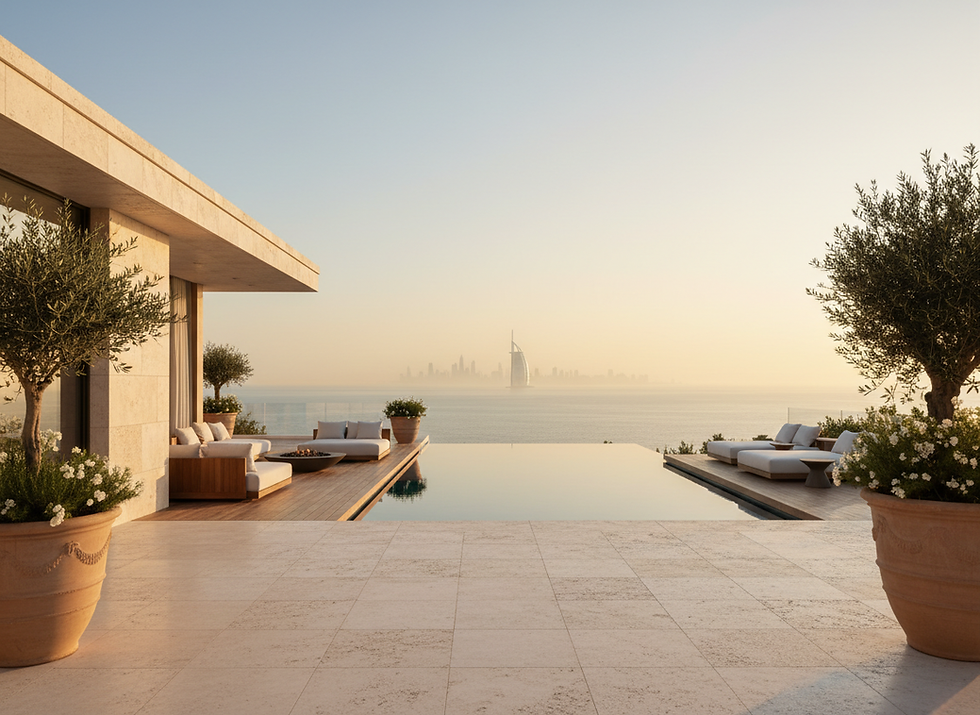
Marbella: a different kind of reassurance
This is where Marbella deserves a more intelligent comparison.
Marbella has never sold itself as a futuristic fortress. Its appeal is quieter. More organic. More Mediterranean. But in moments like this, its strengths become even clearer.
Marbella offers political and territorial distance from the current Middle Eastern conflict. It offers European legal stability, lifestyle continuity, and a form of security that is less about image and more about environment.
For many buyers, that matters deeply.
Not everyone is looking for the newest skyline or the most spectacular branded residence. Many are looking for peace of mind. A place where family life, long-term ownership, and daily rhythm feel protected by more than marketing.
Luxury is also about where you can breathe
There is a broader lesson here.
Luxury today is not only about service, architecture, or tax efficiency. It is also about emotional security. About choosing a destination where one can invest, live, and plan ahead with confidence.
Dubai remains a remarkable market. Its ambition, infrastructure, and global pull are undeniable.
But the current geopolitical reality reminds us that brilliance and vulnerability can coexist.
Marbella, by contrast, offers something less theatrical but increasingly valuable: stability with soul.
Final thought
This is not about declaring one market better than another in every respect.
It is about understanding that buyers are becoming more sensitive to geopolitical context, not less.
For years, Dubai symbolised safety, control, and certainty. Today, that image is being tested.
And in that contrast, Marbella’s value becomes easier to understand: not as a copy of another luxury destination, but as a place where quality of life, European stability, and authentic lifestyle still form one coherent promise.


Comments